" transform="translate(32.822 0)" width="19.883792720350122px"/><path d="M 4.906 4.225 L 9.238 10.504 C 9.519 10.983 9.779 11.366 10.038 11.747 C 10.297 12.129 10.555 12.51 10.835 12.986 L 10.88 13.062 L 10.963 12.977 L 11.117 12.82 L 11.16 12.776 L 11.16 1.949 L 16.514 0 L 16.514 20.749 L 11.489 22.578 L 6.27 16.465 L 5.671 15.407 L 5.633 15.341 L 5.555 15.403 L 5.412 15.516 L 5.355 15.561 L 5.355 24.811 L 0 26.759 L 0 6.011 L 4.906 4.225 Z" fill="transparent" height="26.759472077574316px" id="EqMF0pOOk" stroke-dasharray="" stroke-linecap="butt" stroke-linejoin="miter" stroke-miterlimit="10" stroke-width="0.2" stroke="rgb(208, 213, 221)" transform="translate(36.126 2.313)" width="16.514135092046217px"/><path d="M 0.571 0.941 L 0.576 0.949 L 0.582 0.955 L 5.311 6.496 L 2.668 4.62 L 0 1.498 L 0 0.03 L 0.035 0 Z" fill="rgb(36, 11, 78)" height="6.4963498826103745px" id="xhF4UptH2" stroke-dasharray="" stroke-linecap="butt" stroke-linejoin="miter" stroke-miterlimit="10" stroke-width="0.2" stroke="rgb(36, 11, 78)" transform="translate(41.744 18.063)" width="5.311009991852991px"/><path d="M 0 6.056 L 0 26.749 L 5.346 24.804 L 5.346 15.603 L 5.63 15.364 L 6.265 16.485 L 11.464 22.579 L 16.501 20.744 L 16.501 0 L 11.153 1.944 L 11.153 12.753 L 10.888 13.006 L 10.043 11.738 L 9.213 10.453 L 4.915 4.219 Z" fill="rgb(99, 46, 190)" height="26.749339084640866px" id="F44MxM83b" stroke-dasharray="" stroke-linecap="butt" stroke-linejoin="miter" stroke-miterlimit="10" stroke-width="0.2" stroke="rgb(99, 46, 190)" transform="translate(36.126 2.313)" width="16.500918144741732px"/><path d="M 4.835 4.238 L 0 5.996 L 3.106 8.255 L 7.941 6.422 Z M 16.476 0 L 11.157 1.939 L 14.274 4.122 L 19.583 2.189 Z" fill="rgb(177, 137, 246)" height="8.25464450702497px" id="LiPrfTPBc" stroke-dasharray="" stroke-linecap="butt" stroke-linejoin="miter" stroke-miterlimit="10" stroke-width="0.2" stroke="rgb(177, 137, 246)" transform="translate(32.932 0)" width="19.5831086377803px"/><path d="M 3.108 6.309 L 0 4.057 L 0 24.756 L 3.108 26.947 Z M 11.157 0 L 11.157 8.391 L 14.217 12.952 L 14.266 12.901 L 14.266 2.178 L 11.157 0 Z" fill="rgb(36, 11, 78)" height="26.94671261957273px" id="FFDNWD_EW" stroke-dasharray="" stroke-linecap="butt" stroke-linejoin="miter" stroke-miterlimit="10" stroke-width="0.2" stroke="rgb(36, 11, 78)" transform="translate(32.822 2.093)" width="14.265934535570501px"/><path d="M 6.35 2.311 L 9.255 14.408 L 9.274 14.486 L 9.533 14.58 L 9.551 14.516 L 12.487 4.545 L 18.83 6.853 L 21.705 18.94 L 21.723 19.017 L 21.982 19.112 L 22.001 19.048 L 24.906 9.065 L 30.654 11.157 L 25.101 28.947 L 18.064 26.386 L 15.581 15.959 L 15.562 15.881 L 15.242 15.765 L 15.224 15.829 L 12.74 24.448 L 5.583 21.843 L 0 0 Z M 24.899 9.019 L 21.415 12.116 M 30.666 11.141 L 27.084 14.253 M 8.99 7.6 L 12.483 4.496 M 21.614 32.1 L 25.14 28.93 M 14.579 29.454 L 18.059 26.394 M 9.258 27.597 L 12.744 24.498 M 2.09 24.938 L 5.627 21.806 M 18.185 22.168 L 21.754 18.97 M 12.004 19.045 L 15.488 15.958 M 18.5 22.274 L 21.988 19.16 M 11.751 18.817 L 15.235 15.721" fill="transparent" height="32.1002205379099px" id="V843dyEz8" stroke-dasharray="" stroke-linecap="butt" stroke-linejoin="miter" stroke-miterlimit="10" stroke-width="0.2" stroke="rgb(50, 58, 70)" transform="translate(3.525 0)" width="30.665960167360673px"/><path d="M 3.575 0.209 L 3.648 0.145 L 3.519 0 L 3.446 0.064 L 3.511 0.137 L 3.575 0.209 Z M 0.064 3.196 L 0.129 3.269 L 3.575 0.209 L 3.511 0.137 L 3.446 0.064 L 0 3.123 Z M 3.838 0.32 L 3.911 0.256 L 3.782 0.111 L 3.709 0.175 L 3.774 0.248 L 3.838 0.32 Z M 0.365 3.273 L 0.429 3.346 L 3.838 0.32 L 3.774 0.248 L 3.709 0.175 L 0.3 3.201 L 0.365 3.274 Z" fill="rgb(50, 58, 70)" height="3.3460870544594314px" id="qnjCX1wSL" transform="translate(9.252 14.429)" width="3.910894488797595px"/><path d="M 18.872 10.02 L 22.368 6.911 M 3.506 0 L 0 3.081 M 6.41 5.475 L 9.834 2.401" fill="transparent" height="10.019547563342215px" id="DubNpYsGK" stroke-dasharray="" stroke-linecap="butt" stroke-linejoin="miter" stroke-miterlimit="10" stroke-width="0.2" stroke="rgb(50, 58, 70)" width="22.367698227182288px"/><path d="M 6.35 2.311 L 9.255 14.408 L 9.274 14.486 L 9.533 14.58 L 9.551 14.516 L 12.486 4.545 L 18.83 6.853 L 21.705 18.94 L 21.723 19.017 L 21.982 19.112 L 22.001 19.048 L 24.906 9.065 L 30.653 11.157 L 25.101 28.948 L 18.064 26.386 L 15.58 15.959 L 15.562 15.881 L 15.242 15.765 L 15.224 15.829 L 12.74 24.448 L 5.582 21.843 L 0 0 Z" fill="transparent" height="28.94753770383212px" id="WIWupCH5V" stroke-dasharray="" stroke-linecap="butt" stroke-linejoin="miter" stroke-miterlimit="10" stroke-width="0.2" stroke="rgb(208, 213, 221)" transform="translate(0 3.084)" width="30.65340503593123px"/><path d="M 3.344 0 L 0 2.942 L 6.338 5.259 L 9.659 2.291 Z M 15.874 4.553 L 12.533 7.508 L 18.812 9.788 L 22.165 6.828 L 15.874 4.553 Z M 34.006 11.165 L 28.281 9.077 L 24.955 12.027 L 30.683 14.119 L 34.006 11.165 Z" fill="rgb(102, 213, 224)" height="14.119225039271129px" id="LeZjRwX4q" stroke-dasharray="" stroke-linecap="butt" stroke-linejoin="miter" stroke-miterlimit="10" stroke-width="0.2" stroke="rgb(102, 213, 224)" transform="translate(0.11 0)" width="34.00566216938608px"/><path d="M 6.318 2.299 L 0 0 L 5.565 21.815 L 12.711 24.416 L 15.208 15.745 L 15.518 15.855 L 18.049 26.359 L 25.069 28.914 L 30.62 11.138 L 24.873 9.046 L 21.955 19.082 L 21.701 18.99 L 18.79 6.824 L 12.451 4.525 L 9.505 14.549 L 9.253 14.461 Z" fill="rgb(26, 147, 163)" height="28.914275053115816px" id="DPwUpjFqz" stroke-dasharray="" stroke-linecap="butt" stroke-linejoin="miter" stroke-miterlimit="10" stroke-width="0.2" stroke="rgb(26, 147, 163)" transform="translate(0 3.194)" width="30.620362667670022px"/><path d="M 5.102 7.417 L 3.321 0 L 0 2.97 L 2.856 15.065 L 2.926 15.094 Z M 15.823 4.536 L 12.482 7.499 L 15.288 19.588 L 15.38 19.609 L 17.545 11.886 Z M 8.782 16.643 L 6.46 24.953 L 9.681 22.086 L 9.935 21.204 L 8.922 16.696 Z M 24.323 11.846 L 27.526 9.012 L 22.063 26.534 L 18.825 29.448 Z" fill="rgb(0, 73, 82)" height="29.4484607128612px" id="Cioe0LG2w" stroke-dasharray="" stroke-linecap="butt" stroke-linejoin="miter" stroke-miterlimit="10" stroke-width="0.2" stroke="rgb(0, 73, 82)" transform="translate(6.498 2.423)" width="27.525614209281045px"/></g></g></svg>)
E-COMMERCE
ONLINE ESTATE SALES
ONLINE ESTATE SALES
MODERNIZED
MODERNIZED
USER RESEARCH
USER RESEARCH
EXPERIENCE DESIGN
EXPERIENCE DESIGN
DURATION
1 WEEK
MY ROLE
LEAD RESEARCHER
DELIVERABLES
KEY FINDINGS REPORT
DESIGN RECOMMENDATIONS
DURATION
1 WEEK
MY ROLE
LEAD RESEARCHER
DELIVERABLES
KEY FINDINGS REPORT
DESIGN RECOMMENDATIONS
DURATION
1 WEEK
MY ROLE
LEAD RESEARCHER
DELIVERABLES
KEY FINDINGS REPORT
DESIGN RECOMMENDATIONS
Project Overview
An online estate sale auctioneer was preparing to launch a redesigned iOS app intended to improve the buying experience and make transactions more seamless. The redesign was a key step in staying competitive in a fast-moving digital marketplace, where clearer navigation and smoother purchasing could drive growth. I was brought in to conduct moderated usability testing, uncover last-minute issues, and deliver recommendations that improved the experience without putting the launch timeline at risk.
Project Overview
An online estate sale auctioneer was preparing to launch a redesigned iOS app intended to improve the buying experience and make transactions more seamless. The redesign was a key step in staying competitive in a fast-moving digital marketplace, where clearer navigation and smoother purchasing could drive growth. I was brought in to conduct moderated usability testing, uncover last-minute issues, and deliver recommendations that improved the experience without putting the launch timeline at risk.
Project Overview
An online estate sale auctioneer was preparing to launch a redesigned iOS app intended to improve the buying experience and make transactions more seamless. The redesign was a key step in staying competitive in a fast-moving digital marketplace, where clearer navigation and smoother purchasing could drive growth. I was brought in to conduct moderated usability testing, uncover last-minute issues, and deliver recommendations that improved the experience without putting the launch timeline at risk.
KEY CONSTRAINTS
KEY CONSTRAINTS
Missing User Perspective
The all-male product team lacked direct insight into the needs of its core audience: middle-aged women
Missing User Perspective
The all-male product team lacked direct insight into the needs of its core audience: middle-aged women
Missing User Perspective
The all-male product team lacked direct insight into the needs of its core audience: middle-aged women
Only Quick Fixed
With launch just two weeks away, any recommendations had to be small enough to design and build before release
Only Quick Fixed
With launch just two weeks away, any recommendations had to be small enough to design and build before release
Only Quick Fixed
With launch just two weeks away, any recommendations had to be small enough to design and build before release
My Approach
I used moderated testing and qualitative data coding to identify usability issues and strengthen the case for improvement. This approach helped me understand how target users experienced the app, highlight moments of real friction, and turn raw feedback into actionable recommendations the team could address before launch.
My Approach
I used moderated testing and qualitative data coding to identify usability issues and strengthen the case for improvement. This approach helped me understand how target users experienced the app, highlight moments of real friction, and turn raw feedback into actionable recommendations the team could address before launch.
MY ROLE
Planned and led research, moderated usability testing sessions, and developed conceptual designs.
Planned and led research, moderated usability testing sessions, and developed conceptual designs.
ACTIVITY BREAKDOWN
USER RESEARCH
50%
EXPERIENCE DESIGN
50%

USER RESEARCH
Usability Testing with Target Users
I conducted 10 usability tests with middle-aged women who frequently participated in online estate sales, observing how they searched for items and participated in auctions via the app to evaluate whether the app supported real-world behaviors and expectations.
OUTCOME
A set of usability insights that informed feature refinements and interaction design

USER RESEARCH
Video Annotations
I reviewed and annotated usability test recordings, distilling key moments into short clips that captured real user frustrations and breakdowns, turning raw sessions into compelling evidence of where the experience failed.
OUTCOME
A set of user pain point clips that influenced stakeholder alignment and design decisions

USER RESEARCH
Qualitative Data Coding
I compiled hundreds of quotes and observations from user interviews and usability tests into a spreadsheet, then applied qualitative coding to label and organize the data, revealing patterns and themes that grounded my design thinking.
OUTCOME
A set of coded themes that informed design recommendations
USER RESEARCH
Usability Testing with Target Users
I conducted 10 usability tests with middle-aged women who frequently participated in online estate sales, observing how they searched for items and participated in auctions via the app to evaluate whether the app supported real-world behaviors and expectations.
OUTCOME
A set of usability insights that informed feature refinements and interaction design
USER RESEARCH
Video Annotations
I reviewed and annotated usability test recordings, distilling key moments into short clips that captured real user frustrations and breakdowns, turning raw sessions into compelling evidence of where the experience failed.
OUTCOME
A set of user pain point clips that influenced stakeholder alignment and design decisions
USER RESEARCH
Qualitative Data Coding
I compiled hundreds of quotes and observations from user interviews and usability tests into a spreadsheet, then applied qualitative coding to label and organize the data, revealing patterns and themes that grounded my design thinking.
OUTCOME
A set of coded themes that informed design recommendations
USER RESEARCH
Usability Testing with Target Users
I conducted 10 usability tests with middle-aged women who frequently participated in online estate sales, observing how they searched for items and participated in auctions via the app to evaluate whether the app supported real-world behaviors and expectations.
OUTCOME
A set of usability insights that informed feature refinements and interaction design
USER RESEARCH
Video Annotations
I reviewed and annotated usability test recordings, distilling key moments into short clips that captured real user frustrations and breakdowns, turning raw sessions into compelling evidence of where the experience failed.
OUTCOME
A set of user pain point clips that influenced stakeholder alignment and design decisions
USER RESEARCH
Qualitative Data Coding
I compiled hundreds of quotes and observations from user interviews and usability tests into a spreadsheet, then applied qualitative coding to label and organize the data, revealing patterns and themes that grounded my design thinking.
OUTCOME
A set of coded themes that informed design recommendations
Research Findings
My design recommendations focused on three critical pain points in the online estate sale app: auction awareness, real-time visibility into asynchronous bidding, and clearer insight into how item location affected shipping costs. Together, these improvements gave all bidders—including casual users—the context they needed to participate more confidently and bid more effectively.
Research Findings
My design recommendations focused on three critical pain points in the online estate sale app: auction awareness, real-time visibility into asynchronous bidding, and clearer insight into how item location affected shipping costs. Together, these improvements gave all bidders—including casual users—the context they needed to participate more confidently and bid more effectively.
Research Findings
My design recommendations focused on three critical pain points in the online estate sale app: auction awareness, real-time visibility into asynchronous bidding, and clearer insight into how item location affected shipping costs. Together, these improvements gave all bidders—including casual users—the context they needed to participate more confidently and bid more effectively.
KEY DELIVERABLES
KEY FINDINGS REPORT
DESIGN RECOMMENDATIONS
KEY DELIVERABLES
KEY FINDINGS REPORT
DESIGN RECOMMENDATIONS
Improving Situational Awareness
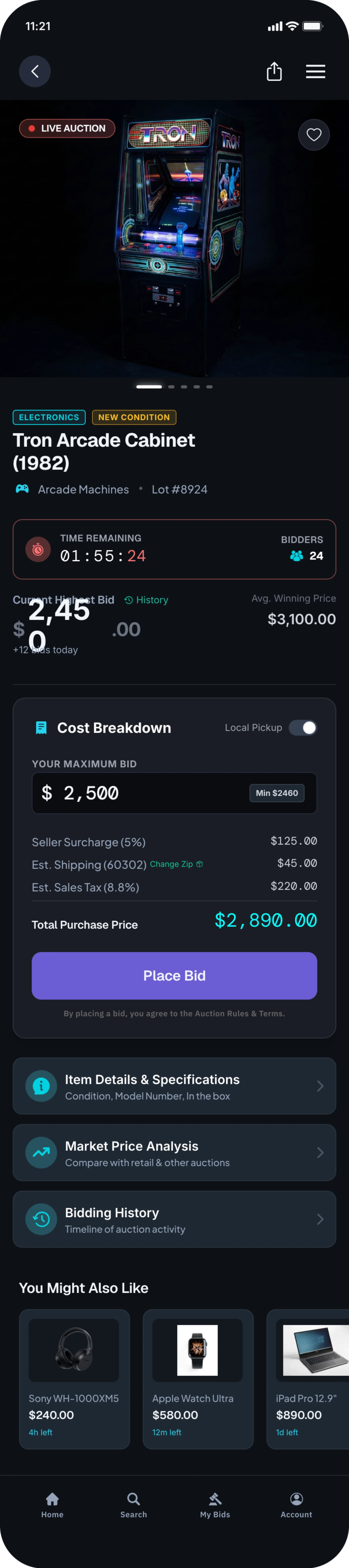
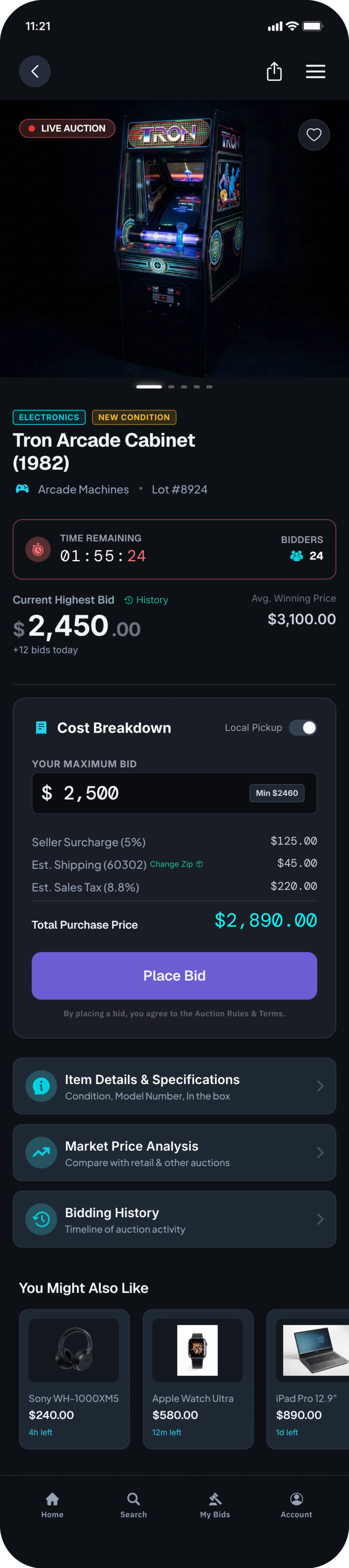
Participants often lacked the situational awareness needed to bid confidently. They were unsure whether they had bid on the correct item, whether they were still winning, how the bid history had changed, and what the final cost would be once shipping was included. The redesigned auction screens brought this information together in a clearer status area, giving bidders an immediate view of their bid, the current leading offer, recent activity, and estimated total cost.
Because users frequently checked auctions in short bursts throughout the day, the experience also needed to work when they were not actively monitoring the app. Push notifications alerted bidders when they were outbid or when an auction status changed, helping casual participants stay informed and competitive without continuously watching the auction.
Visuals have been restyled for confidentiality. Functionality and user experience remain unchanged.
Visuals have been restyled for confidentiality. Functionality and user experience remain unchanged.
Visuals have been restyled for confidentiality. Functionality and user experience remain unchanged.
Visuals have been restyled for confidentiality. Functionality and user experience remain unchanged.
LISTING
ALERTS

Lessons Learned
This project reinforced that late-stage usability testing can still meaningfully improve a product when the research is tightly focused and recommendations are grounded in launch realities. By testing with the app’s core audience and turning user behavior into clear themes, clips, and evidence, I helped the team see issues that had been difficult to recognize from inside the product organization. The strongest findings were not isolated interface defects, but gaps in the information users needed to understand auctions, track bidding, and make confident purchasing decisions. I also learned that effective research at this stage is as much about prioritization and persuasion as discovery. With only two weeks before launch, success meant distinguishing essential fixes from longer-term opportunities and translating broad user frustrations into changes the team could realistically deliver. Rather than treating the deadline as a reason to limit research, I used it as a constraint for making the findings more focused, actionable, and influential.
Lessons Learned
This project reinforced that late-stage usability testing can still meaningfully improve a product when the research is tightly focused and recommendations are grounded in launch realities. By testing with the app’s core audience and turning user behavior into clear themes, clips, and evidence, I helped the team see issues that had been difficult to recognize from inside the product organization. The strongest findings were not isolated interface defects, but gaps in the information users needed to understand auctions, track bidding, and make confident purchasing decisions. I also learned that effective research at this stage is as much about prioritization and persuasion as discovery. With only two weeks before launch, success meant distinguishing essential fixes from longer-term opportunities and translating broad user frustrations into changes the team could realistically deliver. Rather than treating the deadline as a reason to limit research, I used it as a constraint for making the findings more focused, actionable, and influential.
Lessons Learned
This project reinforced that late-stage usability testing can still meaningfully improve a product when the research is tightly focused and recommendations are grounded in launch realities. By testing with the app’s core audience and turning user behavior into clear themes, clips, and evidence, I helped the team see issues that had been difficult to recognize from inside the product organization. The strongest findings were not isolated interface defects, but gaps in the information users needed to understand auctions, track bidding, and make confident purchasing decisions. I also learned that effective research at this stage is as much about prioritization and persuasion as discovery. With only two weeks before launch, success meant distinguishing essential fixes from longer-term opportunities and translating broad user frustrations into changes the team could realistically deliver. Rather than treating the deadline as a reason to limit research, I used it as a constraint for making the findings more focused, actionable, and influential.